 Games
About Tonight's Sky
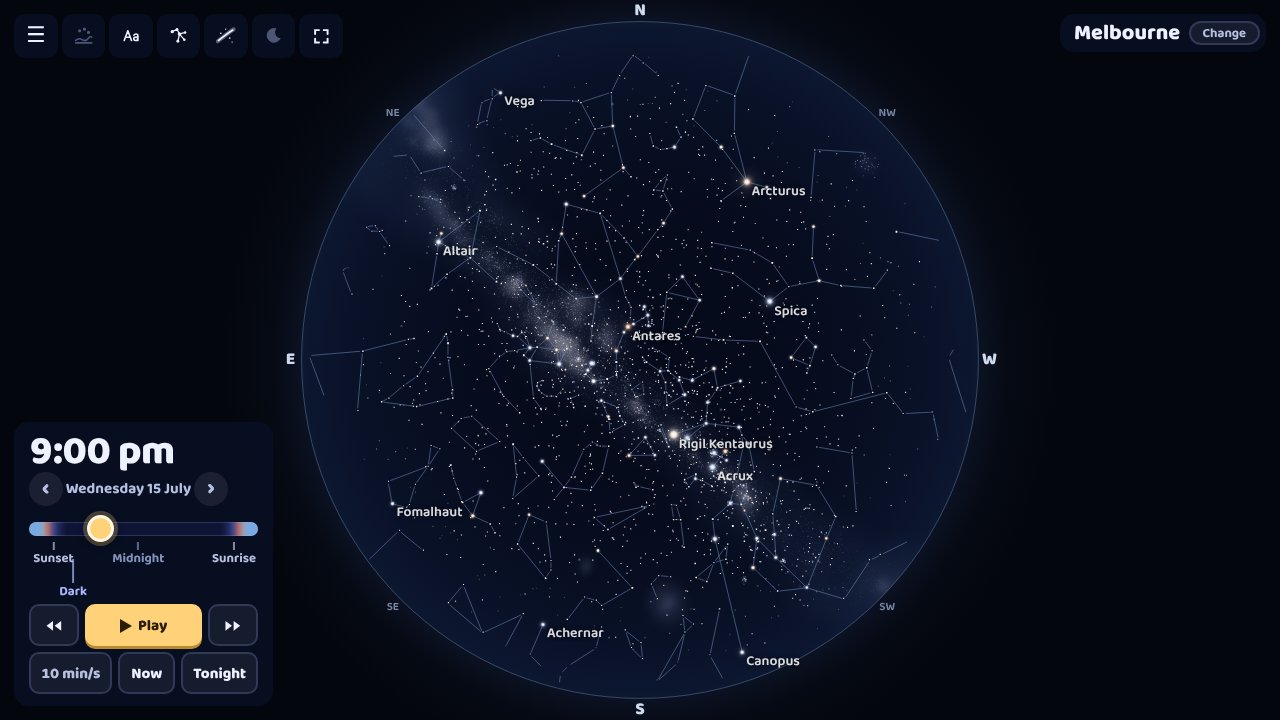
Pick the town the school is in. The board shows the whole sky over it tonight, as if you lay on your back and looked up. The stars, the Moon and the planets are where they really are, and the Moon shows tonight's phase.
Drag the time bar to move through the night, from sunset to sunrise. Press Play and the stars turn round the south pole of the sky, with the Southern Cross circling it. From the northern hemisphere they turn round the north pole instead.
Tap a star and a card says what it is, how far away it is, and the year the light you're seeing left it. Sirius is 8.6 light years away, so the light you see left it about nine years ago. The light from Canopus set off about 300 years ago. Tapping the Moon gives its phase, how far away it is and the date of the next full moon. Tapping a planet gives its distance and how many minutes its light takes to get here.
Press V to stand up and look one way, with hills, gum trees and a school along the horizon. Drag to look around. The Tonight list says when the Sun sets, when it gets dark, where the planets are and what to look for, in plain sentences the class can take outside.
Choices
- Place. Type a town or city, or use this device's location. Every Australian capital and about 40 regional towns are in the list, then New Zealand, the Pacific and the rest of the world.
- Sky. City, Suburbs, Country town or Outback. City shows about 150 stars and no Milky Way. Outback shows about 2,500 and a bright Milky Way.
- Show. Constellation lines, with or without names. Labels for the bright stars, for everything, or none. The Milky Way and the planets on or off.
- Time. Play at 1 minute, 10 minutes or 1 hour a second, or in real time. Step 10 minutes or a day at a time, or jump to now.
Good for
- Earth and space science units
- Day and night: the stars turn because the Earth turns
- The Moon's phases, night by night
- Seasons: why Orion is a summer constellation in Australia and Scorpius a winter one
- Why the other hemisphere sees different stars: try London, then Melbourne
- Light years, and how old the starlight is
- Getting ready for a night out with a telescope or binoculars