 Games
About this game
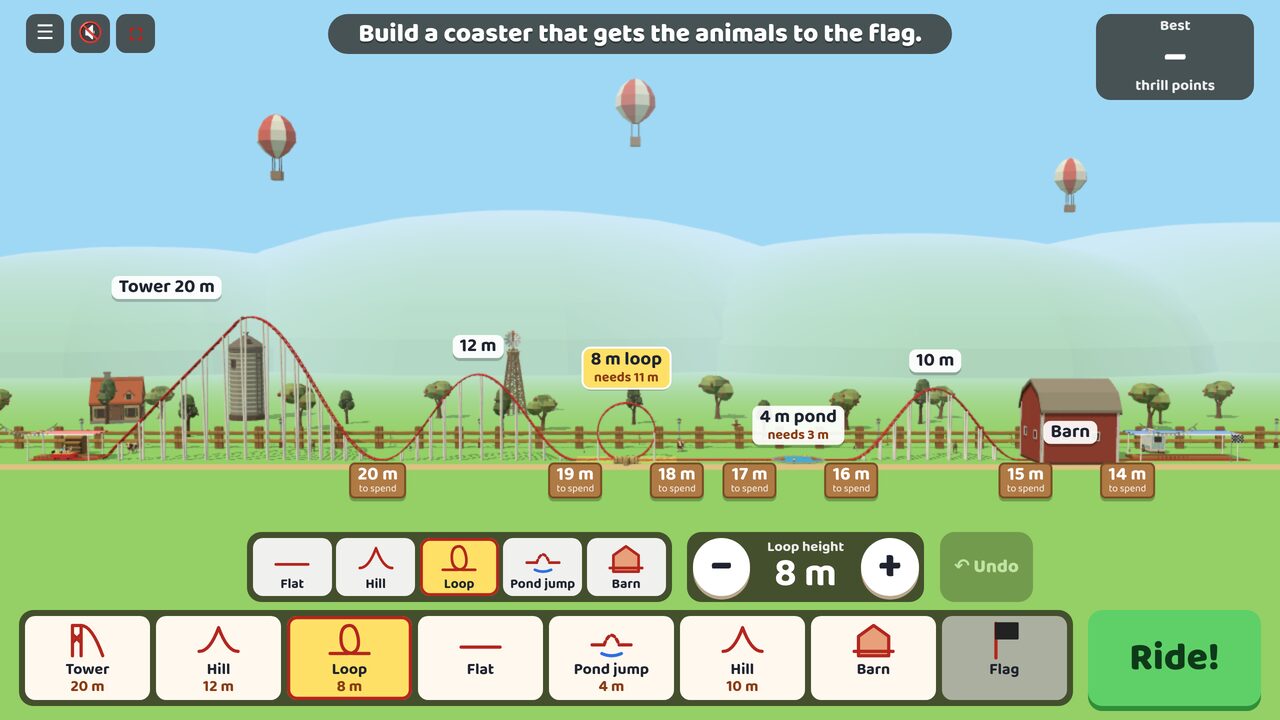
The track has a tower, six pieces and a station. The class chooses each piece (a hill, a loop, a jump over the duck pond, a tunnel through the barn or flat track) and makes it taller or shorter with big − and + buttons. Then a goat, a pig, a sheep and a chicken get in, and the chain pulls them up the tower.
The cart starts with the tower's height to spend. Going up a hill uses some of it, and coming down gets it back. In the Height to spend level, every piece also uses up 1 m, so the wooden signs under the track count down: 20, 19, 18... A hill has to be lower than the sign before it. Untick the signs and the class works the numbers out themselves.
If a hill is too high, the cart stops just short of the top, rolls back, and the animals' hats fall off. A loop that's too big leaves them upside down for a moment, then drops them in the hay. A pond that's too wide ends in a splash. The board then says why: "The sign said 14 m, and the hill is 14 m."
A coaster that reaches the flag scores thrill points, written out as a sum, and the class tries to beat its best. In On a budget, every piece costs money and the class has $60. After each ride, the ride graph shows height and speed second by second.
Good for
- Comparing numbers: is the hill lower than the sign?
- Adding and subtracting heights and keeping a running total
- Adding up costs against a budget
- Reading a line graph: where was it fastest, and why?